
What Led To This Project?
When Edward arrived in the Exploits Valley of Central Newfoundland during the late 1970’s, he was confronted with a challenge. His yard had been typically scraped with a bulldozer mixing the subsoil and valuable but limited topsoil.
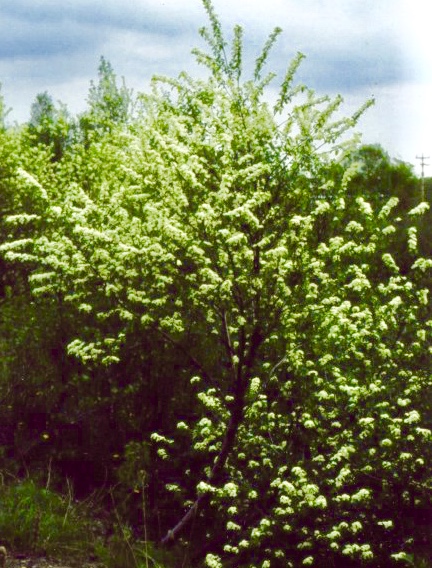
A Healthy Native Cherry Pin Tree In Full Bloom, Growing In A Favoured Micro-Climate & Rich Flood Plain Alluvial Soil Of The Exploits River Valley, Central Newfoundland.
Some surface and subsoil aggregate had been dumped and spread to make a quasi-elevated table top in the front yard contributing to the drainage issues and poor soil quality. Chunks of cement and pavement were in the mixture. This, coupled with the removal of all the native vegetation led to a destitute platform for any green-thumb, let alone a Horticultural Specialist. The constant noise and air pollution associated with all the lawn mowing, trimming, and leaf blowing led him to think, “there had to be a better way”.
The way of thinking at this time in maintaining a lawn was to lime and fertilize with commercially produced products. The end result would be even more mowing with increased noise and toxic carbon exhaust emissions. This is not to mention the purchasing, packaging and shipping costs along with the pollution associated with these products. He was very concerned with the poisonous cosmetic use pesticides being used in the neighborhood where children and pets were playing. He recognized and could instantly smell the fumes.
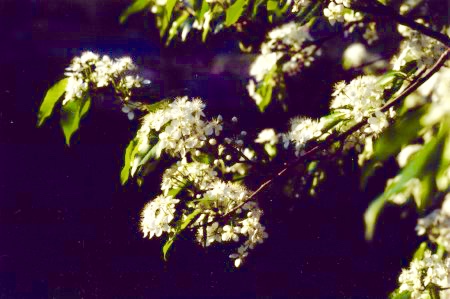
Native Cherry Pin Tree In Full Bloom Growing In The Favoured Climatic & Soil Conditions Of The River Valley, Central Newfoundland.
The young workers applying the pesticides were not wearing protective equipment. He knew there was something terribly wrong with the whole process. This clearly did not make sense. That is, to spend so much time contaminating the neighborhood in the soil, air and water on a collective scale as a cosmetic practice.
Over the next thirty two years, Edward set out to develop a sustainable, ecological, and horticultural system of management in the lawn and garden to demonstrate that there was a better way to create and sustain a lawn and garden without the harmful or wasteful approaches commonly used at that time. His directive was:
- To substantially reduce the climate altering toxic carbon exhaust emissions.
- Drastically reduce noise pollution.
- Eliminate entirely the use of poisonous cosmetic use pesticides on the lawn.
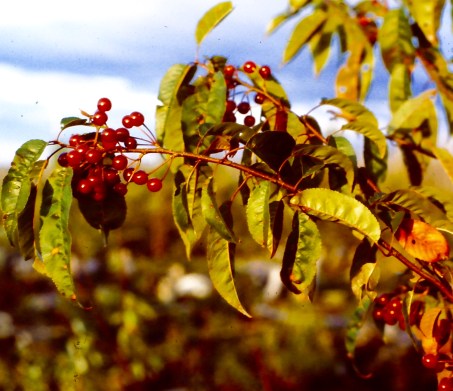
Native Ripe Red Cherries Pin In The Ecological Sustainable Horticultural Garden Attract & Provide Desirable Food For Song Birds.
- Eliminate the unnecessary use and waste of the town’s potable drinking water on the lawn, driveway and walkways.
- Utilize the wet biological organic material from the lawn, garden and kitchen such as grass, leaves, cut up banana peels, tea bags, and eggshells as a free plant food source directly to the soil or in the compost.
- Recycle the dry, fibrous biological organic material from the kitchen, garden and workshop. These materials include bark and woodchips, wood shavings, sawdust, cut up branches, corn cobs and husks, leaves, grass, peat moss, peanut and sunflower seed hulls. Such material adds fibre and organic matter to the soil as a beneficial soil conditioner and as mulch around trees and shrubs to hold in moisture and allow nutrients to be available to improve plant health.
- Plant a representative sample of the native fruit trees, shrubs and plants that were growing well in the Exploits Valley of Central Newfoundland in the lawn and garden.
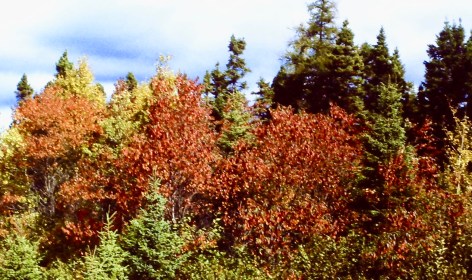
Distinctive Deep Red Foliage Of The Native Cherry Pin In The Autumn, Central Newfoundland.
The number or density, health and vigour of such fruit species revealed the true significance, uniqueness, the favoured micro- climate and the flood plain alluvial soil in the Valley or heartland of the region. The Biodiversity of these fruit trees, shrubs, plants and other species must be preserved. They were being flattened and desecrated with abandon in the name of progress with no land use planning, no stock piling of topsoil or preservation of trees shrubs or plants prior to development.
- Protect flood plains, water courses, and riverbanks. These were being minimized of their former integrity. When flooding or excess waters happens over a short period of time in the Winter on frozen ground, damage is more severe and acute to people and infrastructure close by on the banks or in the flood plains.
 The Sustainable Lawn