
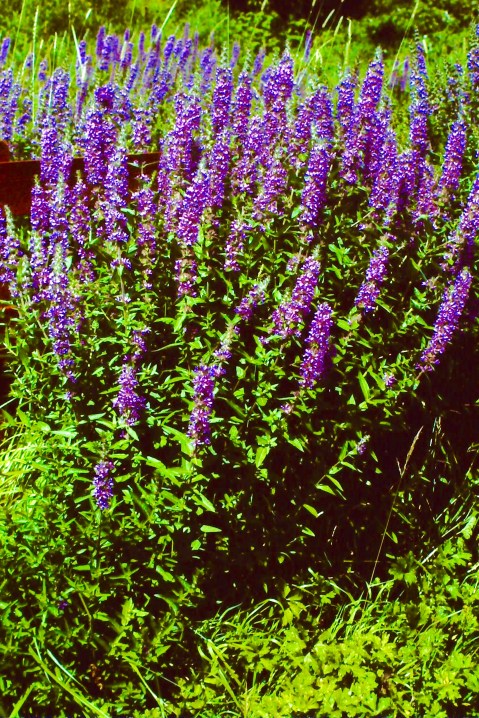
A Well Established & Densely Populated Colony Of Purple Loosestrife In An Aquatic Environment.
Purple Loosestrife or Lythrum salicria of purple spikes or columns of flowers may look beautiful but it is an aggressive plant & is very troublesome. It is choking out many beneficial plants in wet areas including Bull Rushes or Cattails bordering lakes, ponds & canals so that water fowl & wildlife are deprived of their habitat.

A Robust Healthy Purple Loosestrife With Main & Sister Plants Are Flowering & Setting Seed.
A few Purple Loosestrife Plants may be seen first along a ditch beside a road or highway & then they spread down stream into a lake or pond like in South Lake Okanagan, British Columbia.
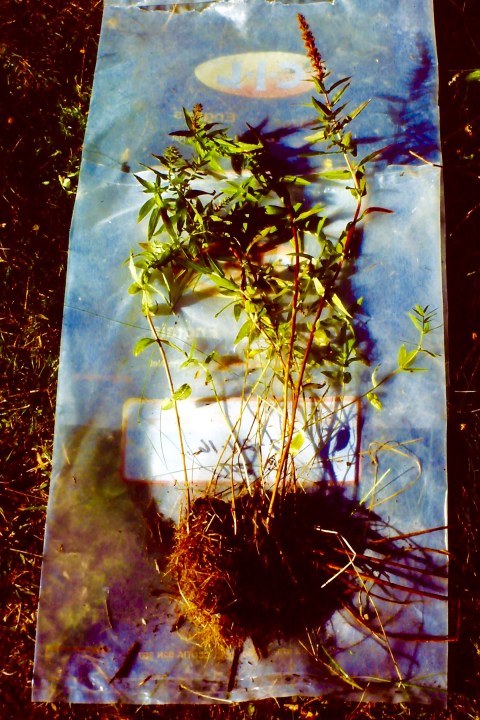
The Tough Resilient Purple Loosestrife Plant With The Extremely Hard Root Needs To Be Dug Out In One Piece, Leaving No Root Pieces Behind To Continue The Infestation.
The Invasion from Europe to North America got started In The !800’s from the Eastern Sea Board of the United States along the Erie Canal near Buffalo, New York. Without it’s Native Predators in North America, Purple Loosestrife has spread across Canada & includes Saskatchewan, PEI & Newfoundland with heavy infestations in Quebec, Ontario & Manitoba. It is on The Noxious Weed List in Manitoba.
Early Infestations may be controlled by removing carefully the Flower Heads & placing them in plastic bags. The bags can be closed & placed in the sun near the Compost to ferment & render them not viable. At the end of the growing season after rotting, they can be Composted to the Bottom Of The Pile. The flower head removal can be done before mid growing season & before the seeds start to set & mature.

The Purple Loosestrife Plants With Roots Dug Out From The Drainage Ditch Are Left On The Gravel Shoulder To Desiccate & Freeze & Die Over The Fall & Winter.
The remainder of the plant can be removed by digging the whole plant up with a Soil Fork & Shovel without leaving any pieces of plant parts behind to Prevent new plants from starting. This operation is easier done with 2 people.The dug Purple Loosestrife Plants can be spread out near the Compost to dry out in the sun & wind plus to freeze during the winter months & composted afterwards.
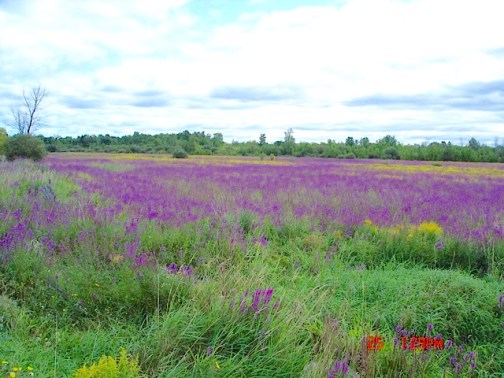
Starting From A Few Plants, The Infestation Of Purple Loosestrife Has Expanded To A Densely Populated Field In Eastern Ontario, South Of Ottawa.
The Control Of This Invasive Species In An Aquatic Environment is very risky & difficult but research is working on Biological Control Methods using The Plant’s Natural Insect Predators from Europe. They are a root weevil Hylobius transversovittatus, and two species of leaf eating beetles, Galerucella pusilla and Galerucella calmariensis. Testing has indicated that these species of insects feed only on L. salicaria or Purple Loosestrife and that the chance of a permanent host transfer is extremely low.

A Few Plants Of Purple Loosestrife Have Expanded To A Densely Populated Field Even Under Dryer Conditions South Of Ottawa In Eastern Ontario.
The Biological Control Methods may reduce the severe infestations but may not eliminate the plant entirely because a certain number plants are needed to keep the Predator Insects in food & alive in enough numbers to maintain adequate control of severe populations of the Invasive Aquatic Weed Species, Purple Loosestrife.
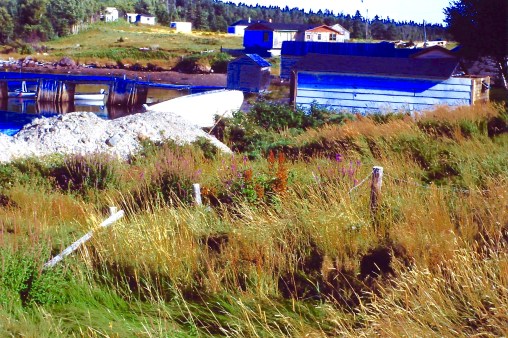
The Purple Loosestrife Of Many Slender Purple Flower Stalks Stand Left Of Centre; The Very Similar Looking But Not To Be Confused With The Curled Dock Of Deep Reddish Copper Flower Stalks In Right Of Centre.
ENVIRONMENTAL IMPACTS OF PURPLE LOOSESTRIFE DEGRADING WILDLIFE HABITAT:
*displaces plants and animals
* replaces native wetland communities
*eliminates food and shelter for wildlife species
* reduces biodiversity
* impacts fish spawning habitats
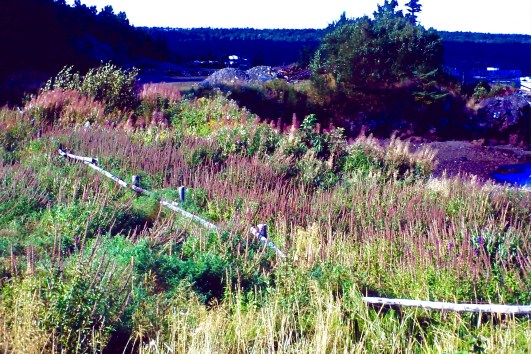
The Purple Loosestrife Of Deep Purple Slender Flower Stalks Are In The Foreground; The Very Similar Looking But Not To Be Confused With The Fire Flower Of Purple, Pink Flowers With White Seed Stalks In The Background.
* reduces available waterfowl habitats
* threatens marches, ponds, bogs & sloughs where a large portion of North America’s waterfowl breed
*impairment of recreational uses of wetlands

Similar Looking Plants To The Purple Loosestrife But Not To Be Confused Are The Fire Flower Of Tall Pinkish Purple Flower Stalks Plus The Purple Vetch With Short Purple Flower Stalks.
DEGRADING AGRICULTURAL LANDS
* impedes water flow in drainage and irrigation ditches
* reduces crop yields and quality
* reduces agricultural land value
*threatens commercial wild rice production
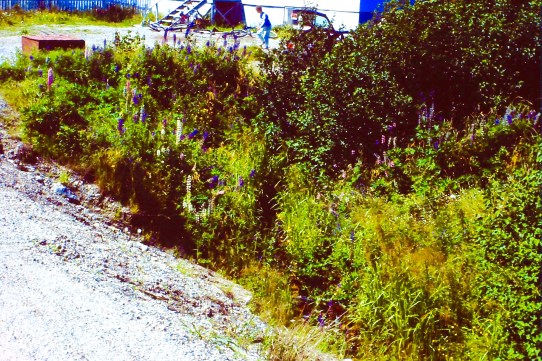
Flower Stalks Of Pink, Purple & White Lupins In A Drainage Ditch Of A Residential Area Of Charlottetown, Terra Nova National Park, Eastern Newfoundland. The Purple Pink Lupin Flower Stalks Could Be Confused With Purple Loosestrife Flowers !
With the support of Environment Canada, Canadian Wildlife Service, Canadian Wildlife Federation & The Canadian Nursery Trades Association, Ducks Unlimited has spear headed an Public Awareness & Reporting Infestation Campaign complete with a colourful Brochure called “Purple Loosestrife”.

The Spiraea Plants With Purple Conical Flowers In The Current Year Can Be Mistaken For Purple Loosestrife Flowers. The Brown Flowers Of The Spiraea Plant Are From The Previous Year. These Healthy Flowering Plants Were Found In Cornor Brook, Newfoundland.
 The Sustainable Lawn