Category: Invasive Species Purple Loosestrife


                               Bishop’s Falls Fighting Purple Loosestrife                                                                                                                                                                                          The Advertiser,  Grand Falls-Windsor, NL.  Mon. Sept  30, 1996, By Michelle Jesso

SCHOOL, SCOUTS HELP COMBAT INFESTATION

The battle against the Purple Loosestrife continues to be waged in the Exploits Valley. The latest attempt to control the Invasive Purple Plant is in Bishop’s Falls, where the plant was first discovered in Central Newfoundland more than four years ago. Ed Kayler, an Extension Horticulturist with the Department of Forest Resources & Agrifoods, has voluntarily taken up the plight of reducing & eventually eliminating the existence of the plant in this area & calls upon community groups to assist in the effort. The beautiful flowering plant can easily fool people into making it an addition to their gardens but that act would not help the fight to get rid of the botanical nuisance.

My beautiful picture

Purple Loosestrife In A Garden, Spread From A Drainage Ditch In A Residential Area Of Charlottetown, Terra Nova National Park, NL

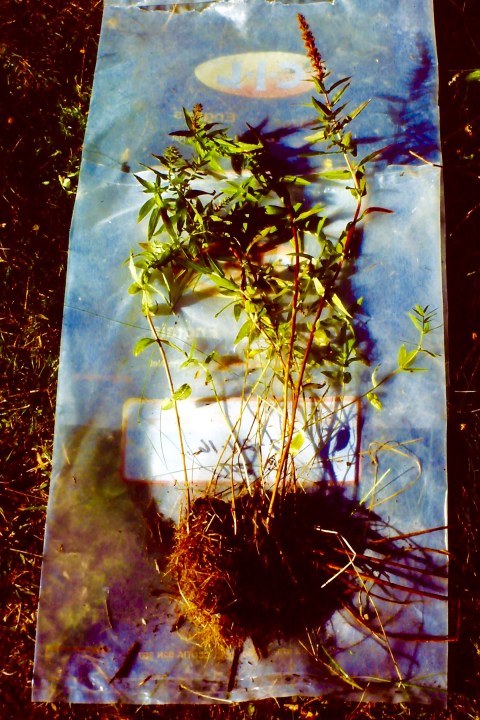
The Purple Loosestrife has distinguishing features upon close examination such as its height, which ranges from three to six feet; its stalk[s], which is square & woody; its leaves, which have smooth edges & are attached directly to the stalk; its flowers, which have long pink-purple spikes & bloom from June to September.

Once it gains a foothold in any wetland, it destroys the natural habitat.
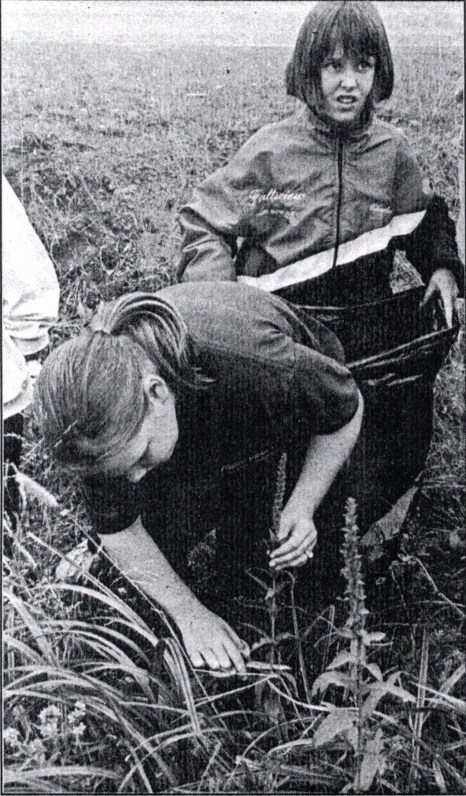
Kayla Walsh learned how to remove Purple Loosestrife Plants in Bishop's Falls area.

Kayla Walsh Learned How To Remove Purple Loosestrife Plants Including The Flowers With Seeds & Roots In The Bishop’s Falls Area, Central Newfoundland.

Local Efforts

The Horticulturist was joined by the Fourth Knights of Columbus Scouts & Ventures Troops plus  several Science Students of Helen Tulk Elementary School’s Global Education Program to nip the problem “in the bud” at the bottom of the middle access road leading into Bishop’s Falls. They were told by Mr. Kayler to keep an account of how many plants they dug up & were given Tally Sheets [See Bottom Of Page] for Recording The Number Of Flower Spikes & Plants plus shovels, scissors, garbage bags & crow bars to ensure the entire plant & root were recovered. “These are young plants which means we have a chance in controlling the population” said Mr. Kayler. “In some areas, the seeds have been there for a while. In this area, it is an intersection which has running water that can lead to spreading of seeds & infect other areas.” Mr. Kayler said the local effort displayed by the Scouting Group & the Schools’s Science Class is an education for them about the plant, what it does to the natural habitat & how it can be controlled.
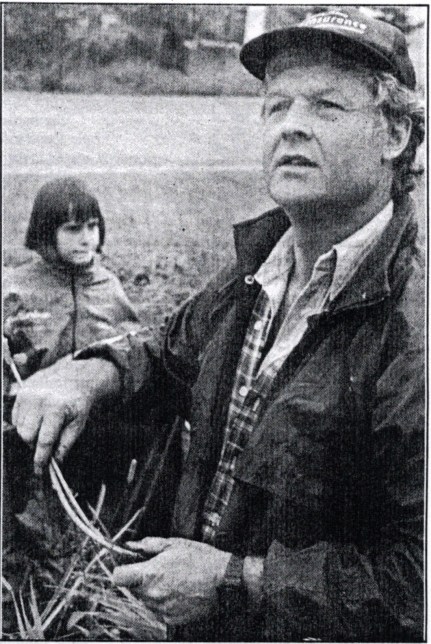
Ed Kayler, an Extension Horticulturist with the Dept.Forest Resources & Agrifoods, has been actively involved in trying to control & eliminate Purple Loosestrife in the area. His latest project,with the help of Scouting Troops & Helen Tulk Elementary Students, was to go into Bishop's Falls at the bottom of the middle access road to dig up the Plant & Prepare them for Composting.

Ed Kayler, An Extension Horticulturist With The Dept.Forest Resources & Agrifoods, Has Been Actively Involved In Trying To Control & Eliminate Purple Loosestrife In The Area. His Latest Project With The Help Of Scouting Troops & Helen Tulk Elementary Students, Was To Go Into Bishop’s Falls At The Bottom Of The Middle Access Road To Dig Up The Plants & Prepare Them For Composting.


He showed them how to remove the roots, which can grow as large as a football, dry them & place the plants in garbage bags to put into a compost pile, behind the local Catholic Church.”That way the Scouts can keep a close eye on the pile through out the year, ”said the Horticulturist. “The have their meetings there.”

By contributing to the efforts to control the plant population in that area, the volunteer groups benefit through education. The Scouts & Ventures usually have to complete Projects in order to earn Badges. In this case, they would be able to earn recognition for Community Service, Conservation, World Conservation & work towards their Chief Scout Badge.

For Helen Tulk Elementary, this is the fourth year it has been involved in the attack on Purple Loosestrife. Students involved in Global Education at the School, under Teacher Sandra Knight, plus three other Teachers, means they can work toward Earth Status in the Program. The School has already achieved Emerald Status, which means it has completed more than 600 Projects In Environmental Awareness. Their Aim is to complete 400 more to reach Earth Status.

Weed Control Research & Demonstration Program For Purple Loosestrife

                                                                Tally Sheet                                                        

Location                                                        Site                                               Date


No. of Spikes of Blooms Per Crown                                                                  Total

       1        2       3       4       5       6          6+                                                        

                 No. of Stems Per Crown                                                                     Total

        1        2       3       4       5        6          6+                                                         

                  No. of Crowns                                                                                      Total

       1        2       3        4       5        6          6+                                                            

Student Participants                                                                    Coordinator

Contributing Organization or Institution 

                                                                                                  NL AgriFoods, Bishop’s Falls 
My beautiful picture

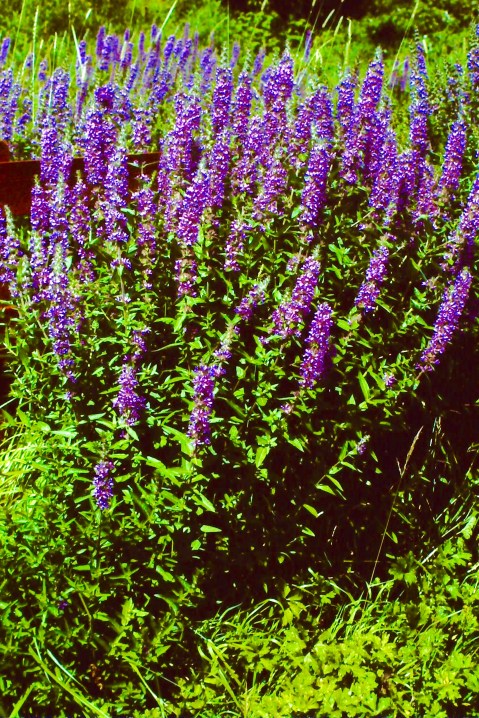
A Well Established & Densely Populated Colony Of Purple Loosestrife In An Aquatic Environment.


Purple Loosestrife or Lythrum salicria of purple spikes or columns of flowers may look beautiful but it is an aggressive plant & is very troublesome. It is choking out many beneficial plants in wet areas including Bull Rushes or Cattails bordering lakes, ponds & canals so that water fowl & wildlife are deprived of their habitat.

A Robust Healthy Purple Loosestrife Main & Sister Plants Flowering & Setting Seed

A Robust Healthy Purple Loosestrife With Main & Sister Plants Are Flowering & Setting Seed.


A few Purple Loosestrife Plants may be seen first along a ditch beside a road or highway & then they spread down stream into a lake or pond like in South Lake Okanagan, British Columbia.

My beautiful picture

The Tough Resilient Purple Loosestrife Plant With The Extremely Hard Root Needs To Be Dug Out In One Piece, Leaving No Root Pieces Behind To Continue The Infestation.


The Invasion from Europe to North America got started In The !800’s from the Eastern Sea Board of the United States along the Erie Canal near Buffalo, New York. Without it’s Native Predators in North America, Purple Loosestrife has spread across Canada & includes Saskatchewan, PEI & Newfoundland with heavy infestations in Quebec, Ontario & Manitoba. It is on The Noxious Weed List in Manitoba.

Early Infestations may be controlled by removing carefully the Flower Heads & placing them in plastic bags. The bags can be closed & placed in the sun near the Compost to ferment & render them not viable. At the end of the growing season after rotting, they can be Composted to the Bottom Of The Pile. The flower head removal can be done before mid growing season & before the seeds start to set & mature.

My beautiful picture

The Purple Loosestrife Plants With Roots Dug Out From The Drainage Ditch Are Left On The Gravel Shoulder To Desiccate & Freeze & Die Over The Fall & Winter.

The remainder of the plant can be removed by digging the whole plant up with a Soil Fork & Shovel without leaving any pieces of plant parts behind to Prevent new plants from starting. This operation is easier done with 2 people.The dug Purple Loosestrife Plants can be spread out near the Compost to dry out in the sun & wind plus to freeze during the winter months & composted afterwards.

DSC06540

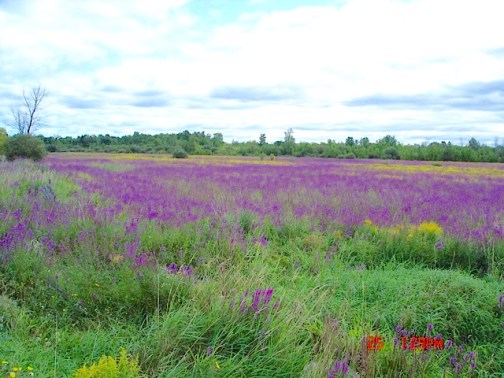
Starting From A Few Plants, The Infestation Of Purple Loosestrife Has Expanded To A  Densely Populated Field In Eastern Ontario, South Of Ottawa.


The Control Of This Invasive Species In An Aquatic  Environment is very risky & difficult but research is working on Biological Control Methods using The Plant’s Natural Insect Predators from Europe. They are a root weevil Hylobius transversovittatus, and two species of leaf eating beetles, Galerucella pusilla and Galerucella calmariensis. Testing has indicated that these species of insects feed only on L. salicaria or Purple Loosestrife and that the chance of a permanent host transfer is extremely low.

DSC06545

A Few Plants Of Purple Loosestrife Have Expanded To A Densely Populated Field Even Under Dryer Conditions  South Of Ottawa In Eastern Ontario.


The Biological Control Methods may reduce the severe infestations but may not eliminate the plant entirely because a certain number plants are needed to keep the Predator Insects in food & alive in enough numbers to maintain adequate control of severe populations of the Invasive Aquatic Weed Species, Purple Loosestrife.

My beautiful picture

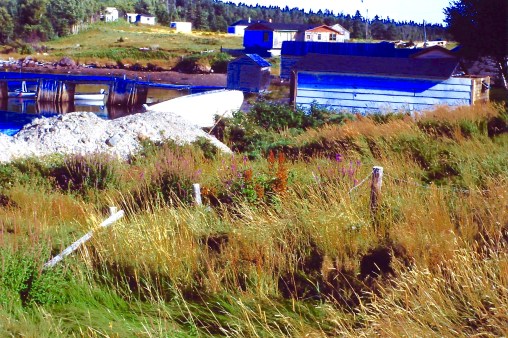
The Purple Loosestrife Of Many Slender Purple Flower Stalks Stand Left Of Centre; The Very Similar Looking But Not To Be Confused With The Curled Dock Of Deep Reddish Copper Flower Stalks In Right Of Centre.


ENVIRONMENTAL IMPACTS OF PURPLE LOOSESTRIFE DEGRADING WILDLIFE HABITAT:

*displaces plants and animals

* replaces native wetland communities

*eliminates food and shelter for wildlife species

* reduces biodiversity

* impacts fish spawning habitats

My beautiful picture

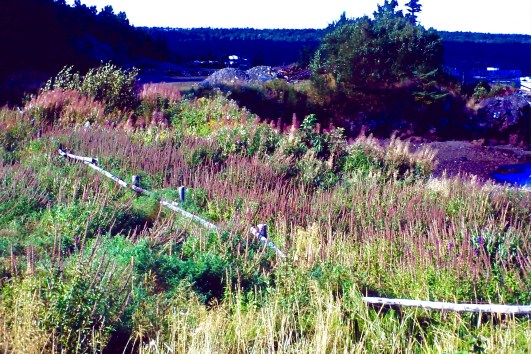
The Purple Loosestrife Of Deep Purple Slender Flower Stalks Are In The Foreground; The Very Similar Looking But Not To Be Confused With The Fire Flower Of Purple, Pink Flowers With White Seed Stalks In The Background.

* reduces available waterfowl habitats

* threatens marches, ponds, bogs & sloughs where a large portion of North America’s waterfowl breed

*impairment of recreational uses of wetlands

My beautiful picture

Similar Looking Plants To The Purple Loosestrife But Not To Be Confused Are The Fire Flower Of  Tall Pinkish Purple Flower Stalks Plus The Purple Vetch With Short Purple Flower Stalks.

DEGRADING AGRICULTURAL LANDS

* impedes water flow in drainage and irrigation ditches

* reduces crop yields and quality

* reduces agricultural land value

*threatens commercial wild rice production

My beautiful picture

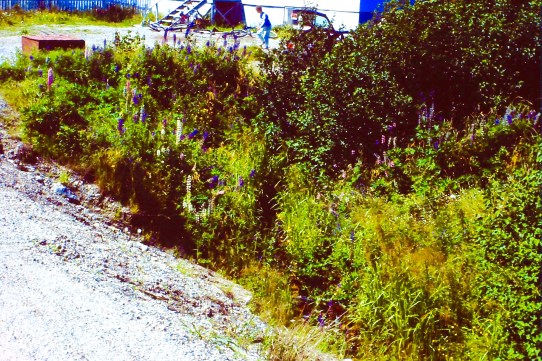
Flower Stalks Of Pink, Purple & White Lupins In A Drainage Ditch Of A Residential Area Of Charlottetown, Terra Nova National Park, Eastern Newfoundland. The Purple Pink Lupin Flower Stalks Could Be Confused With Purple Loosestrife Flowers !

With the support of Environment Canada, Canadian Wildlife Service, Canadian Wildlife Federation & The Canadian Nursery Trades Association, Ducks Unlimited  has spear headed an Public Awareness & Reporting Infestation Campaign complete with a colourful Brochure called “Purple Loosestrife”.

My beautiful picture

The Spiraea Plants With Purple Conical Flowers In The Current Year  Can Be Mistaken For Purple Loosestrife Flowers. The Brown Flowers Of The Spiraea Plant Are From The Previous Year. These Healthy Flowering Plants Were Found In Cornor Brook, Newfoundland.